01 · The decision
Why Copenhagen
We are a small team building an AI twin - a version of you that speaks in your voice, works from knowledge you have approved, and can hold a conversation while you are somewhere else. That is an easy product to describe badly on a website and an easy product to understand in ten seconds in person. So we went looking for a room full of people who would tell us, to our faces, whether the idea holds up.
TechBBQ was the obvious candidate. It is the largest startup and innovation summit in the Nordics, it draws founders and investors from across Denmark, Sweden, Norway, Finland and the Baltics, and - unusually for a summit of that scale - it has kept an informal register. The name is not ironic. People talk to each other.
02 · Context
What TechBBQ actually is, if you've never been
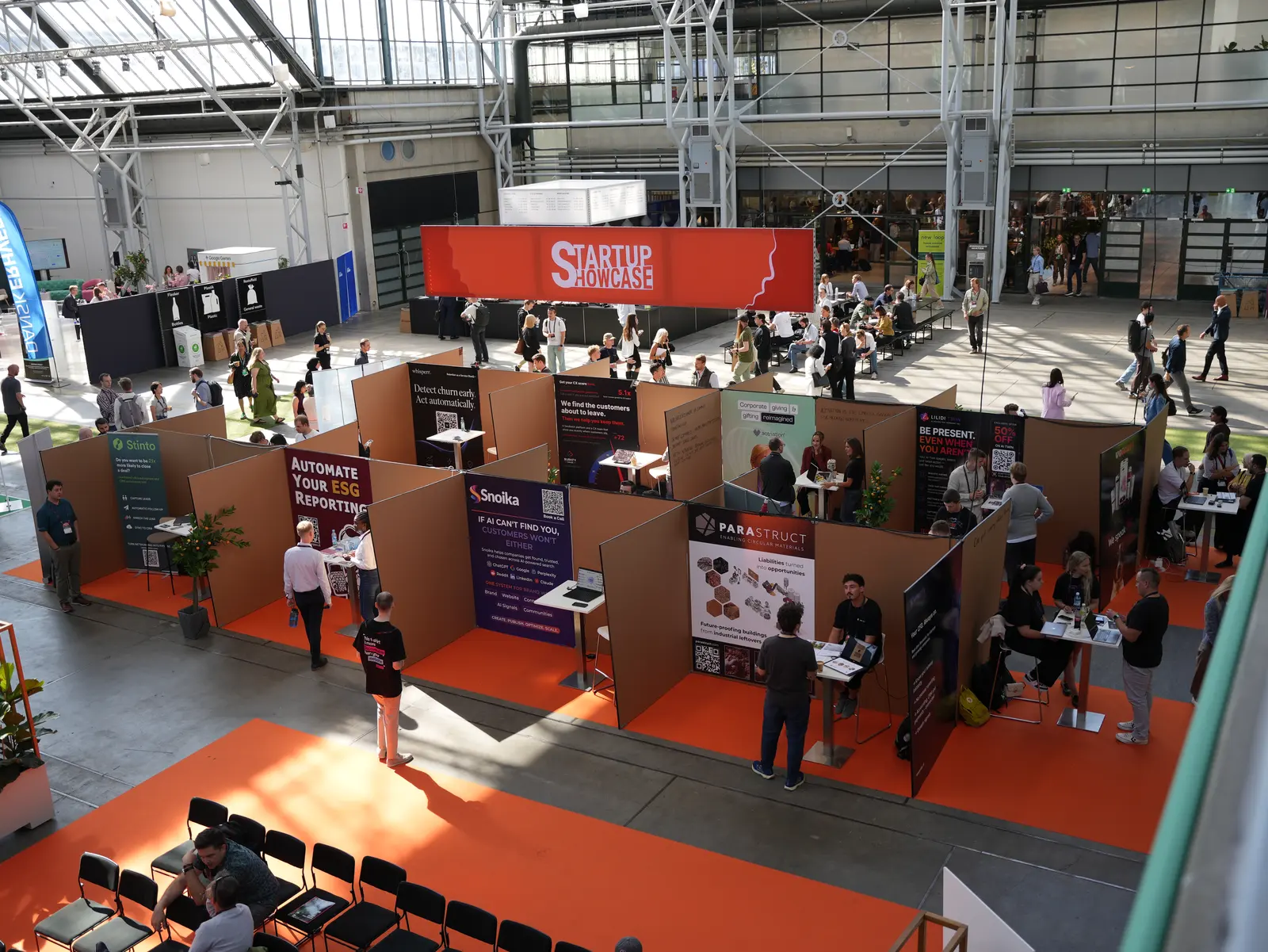
Bella Center in Ørestad, about ten minutes on the metro from Copenhagen Airport and fifteen from the city centre. Two days. Several stages running in parallel, a large exhibition floor, a curated Startup Showcase for early-stage companies, a scaleup track called Beyond Beta, and an investor matchmaking programme underneath all of it.
The halls sit under a glass roof, which sounds like a detail and is not: the light changes how the whole event feels. There is greenery on the floor, benches between stands, and enough space that a conversation does not have to be shouted. If you have done the windowless-basement conference circuit, you will notice within about a minute.
03 · The floor
The Startup Showcase, and why it is the good part
The Startup Showcase is the curated strip of small booths for early-stage companies, laid out along orange walkways in the middle of the main hall. It is where the density is. Everyone walking that aisle has already decided they want to look at young products, which means you spend almost none of your day explaining why you exist to people who wandered in by accident.
Booths are small on purpose. You get a wall, a table, a stool and about four seconds of a passerby's attention. That constraint is the best editing exercise a founder can do - it forces you to find the one sentence that makes someone stop walking.
04 · E-S12
Running booth E-S12 with two people
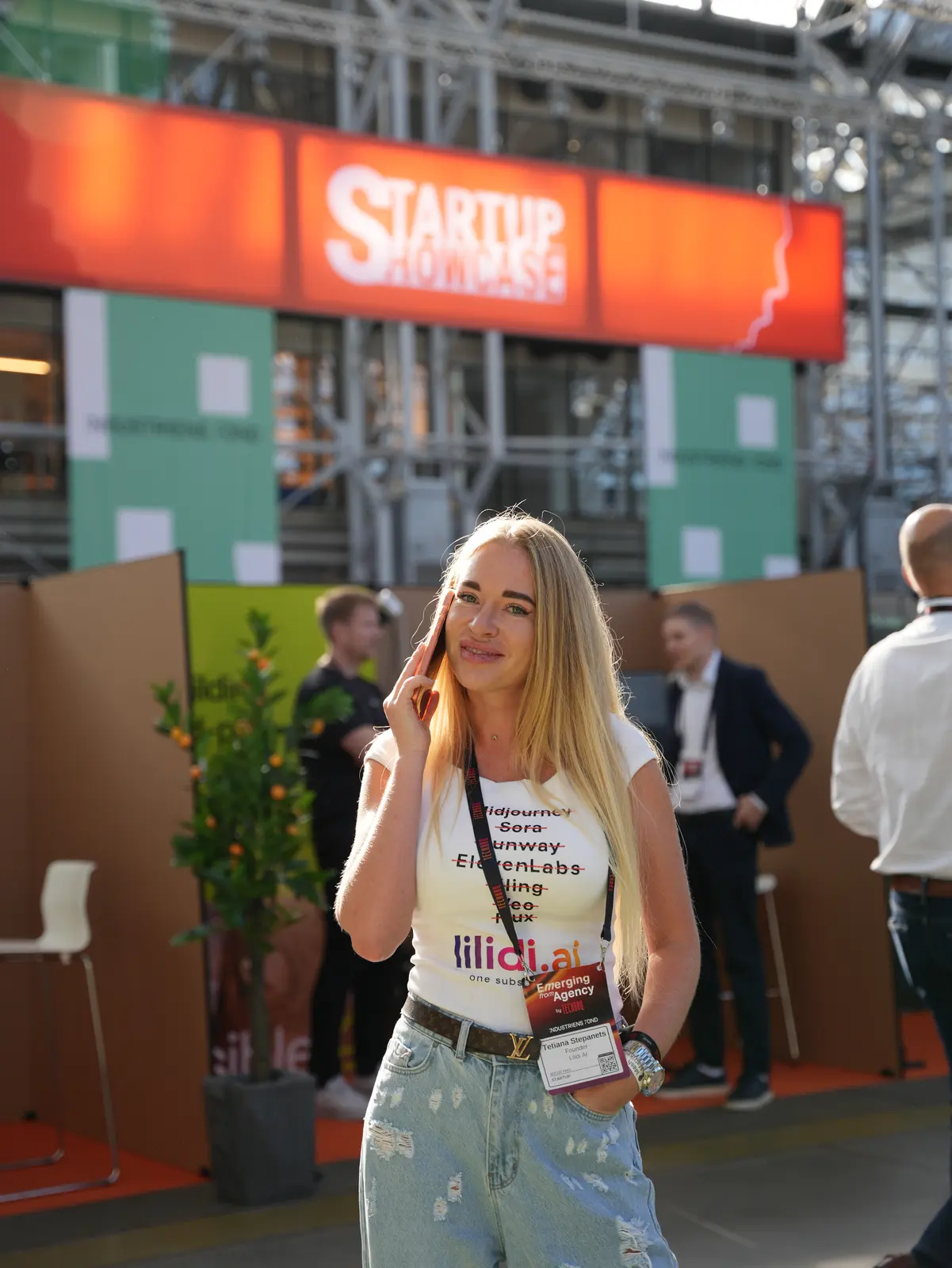
Our wall said: Be present, even when you aren't. Under it, a laptop with a live Twin running, and a QR code to a show offer. That was the whole stand. No printed brochures, no tote bags, no bowl of sweets.
The banner has to do the work you cannot. If it needs a second sentence to make sense, it needs a rewrite, not a bigger font.
Two people is workable, three is comfortable, one is a mistake. With two you can keep the demo running while the other walks the hall, sits in a session, or queues at a cloud stand. With one, you are chained to a table for two days and you will miss the half of the conference that is not your booth.
05 · The demo
What we demoed, and what people asked
The demo was deliberately boring in structure: a Twin with a face and a voice, answering a question about the company it works for, out loud, in real time. No slides. Whoever was standing in front of us could ask it something and hear the answer.
The three questions we were asked most, in order:
- “Where does it get the answers from?” - the knowledge question. People are past being impressed by fluency; they want to know the source and who approved it.
- “What stops it from saying something wrong to my customer?” - the guardrail question. Nobody buys an agent without a handoff rule.
- “Can it join my actual calls?” - the workflow question, and the one that turns a demo into a meeting.
Not one person asked about the model underneath. That was the single clearest signal of the two days: the market has stopped shopping for models and started shopping for accountability.
06 · On stage
The agentic era, on stage and on the floor
AWS and NVIDIA ran a dedicated track called The Agentic Era: Building What's Next, complete with a live poll asking how much of the room's codebase is already AI-written. The answers were higher than the same room would have admitted a year ago.
What struck us was the change in the questions from the audience. Fewer “can it do this”, far more “who is responsible when it does it wrong”. Agentic AI has crossed from novelty into procurement, and procurement asks about logs, limits and escalation paths.
07 · Photo story
Two days in Copenhagen, in twelve frames
Shot on the floor at Bella Center. Select any frame for a larger view.
08 · People
The part that doesn't fit in a recap: the people
Conference write-ups always default to sessions and statistics, because those are easy to list. The actual return on two days in Copenhagen was a handful of conversations that would not have happened over email.
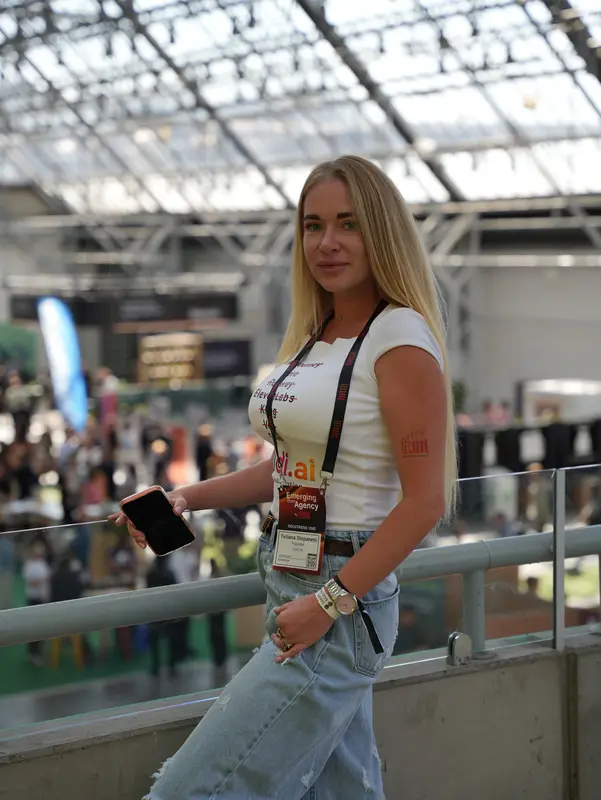
Rui Lin was one of the people who made the Startup Showcase feel genuinely welcoming rather than transactional. A large part of what worked for us at TechBBQ came down to the people behind the event creating an environment where founders could actually meet, exchange ideas and get useful feedback rather than simply occupy a table for two days.
Varan Pathmanathan and a great conversation about innovation, founders and where AI products are heading next. Some of the best exchanges at TechBBQ were the spontaneous five-minute ones that unexpectedly became much deeper discussions - this was one of them.
Lean Milo brought a different perspective: investor, strategic adviser, and someone genuinely interested in the connection between Nordic and Ukrainian technology. Our conversation moved naturally from Lilidi Twin to the wider startup and technology ecosystem, and to where a small European team can realistically compete.
Thank you to the TechBBQ team for running a showcase that felt curated rather than sold, and to everyone who stopped at E-S12 to argue with us about what an AI twin should and should not be allowed to do. Those arguments are already changing the product.
09 · Infrastructure
Cloud, credits and the stands worth queueing for
If you are early-stage and self-funding your compute, the cloud stands are worth the queue. Google for Startups, AWS, NVIDIA and Nebius all had teams on the floor who could answer credit and architecture questions directly rather than routing you to a form.
Our practical advice: go on the morning of day one, before the queues form, and arrive with your monthly spend and your bottleneck written down. “We spend roughly X on inference and latency is our constraint” gets a useful answer in five minutes. “Tell me about your startup programme” gets you a leaflet.
Google Cloud, and the people helping startups scale
One of the people we were especially happy to meet was Simon Olsson from Google Cloud. Simon works closely with the Nordic startup ecosystem, helping founders understand how Google Cloud can support a company as it moves from experiments into real products and real infrastructure. For us those conversations are becoming more relevant as Twin grows and our infrastructure requirements become more serious. And yes, the Google conversation also ended with a Copenhagen bicycle.
Nebius
It was also great catching up with Rami Deeb from Nebius. We had met before, so TechBBQ became a chance to continue the conversation around AI infrastructure, compute, and what happens when an AI product starts moving from experimentation toward serious scale. We have also applied to a Nebius startup programme as we explore infrastructure for Lilidi Twin and future model training and fine-tuning. For a self-funded AI startup, compute stops being an abstract technical topic very quickly - it becomes part of the business model.
Building on AWS
We also spent time talking with Patrick Obinna from Automat-it, an AWS ecosystem partner working with startups around AI, DevOps, data and cloud infrastructure. For Lilidi Twin these conversations matter because inference cost, latency, reliability and eventually model training are no longer theoretical questions. They directly affect what kind of AI employee product we can build, and how efficiently we can scale it. Sometimes fifteen minutes with someone who works on these problems every day saves weeks of figuring things out alone.
10 · Read
What TechBBQ tells you about the Nordic ecosystem
Three things were consistent enough across two days to be worth stating plainly.
Sustainability is not a track, it is a default. Climate and impact language shows up in ordinary B2B pitches without anyone flagging it as a theme.
Public and private sit closer together than elsewhere. Innovation agencies and municipal programmes exhibit next to venture funds, and founders treat both as normal routes to a first customer.
The bar for AI claims has risen. Saying “AI-powered” buys nothing. Showing a working thing, with its limits stated, buys a follow-up meeting.
11 · Retro
What worked for us
- A one-sentence banner that made people stop mid-stride.
- A live demo instead of a screen recording - the pause before the Twin answers is what convinces people it is real.
- A show-only offer on a QR code, so interest could convert on the spot instead of in a follow-up email nobody opens.
- Two shifts, so one of us was always on the floor rather than behind the table.
- Writing one line of context next to every contact within a minute of the conversation.
12 · Retro
What we'd do differently
- Book meetings before arriving. We relied on foot traffic for day one and lost hours we could have scheduled.
- Bring a second demo device. One laptop is a single point of failure, and the socket is never where you need it.
- Prepare a quiet-room version of the demo. The hall is loud, and voice products are unfairly penalised by ambient noise.
- Block one session per day in the calendar. Without it, the booth eats the entire programme.
- Send follow-ups the same evening. By the second morning, everyone has met forty more people.
13 · Evergreen
The exhibitor playbook we'd hand to any founder
None of this is specific to Copenhagen. It applies to any startup conference where you are paying for a small booth and two days of your team's time.
- 01
Write the one-line answer before you print anything
Visitors give you about four seconds of attention while walking. Our banner said “Be present, even when you aren't.” People stopped because they understood the promise before we said a word. Everything else on the wall was secondary.
- 02
Demo the outcome, not the dashboard
The demo that landed was a Twin answering a real customer question out loud. Nobody asked to see settings screens. If your product needs configuration to be impressive, pre-configure it and show the result.
- 03
Have a thirty-second version and a ten-minute version
Investors and operators walk at different speeds. We kept a short pitch for the aisle and a seated version for anyone who pulled up a stool. Trying to give the ten-minute version to everyone burns the day.
- 04
Capture the follow-up on the spot
Business cards get lost, and badge scanners give you a name without context. We typed one line of context next to every contact within a minute of the conversation ending. That line is the difference between a warm follow-up and a cold one.
- 05
Staff the booth in shifts and actually leave it
Half the value of a conference is on the other side of the hall. Two people means one can walk the floor, sit in a session, or queue at a cloud stand while the booth stays live.
- 06
Bring your own power, extension lead and a spare laptop charger
This is unglamorous and it is the tip most exhibitors wish someone had given them. A live demo dies at 4% battery, and the nearest socket is never behind your stand.
- 07
Decide what a good day means before day one
Ours was: number of real product conversations, not badge scans. Deciding the metric in advance stops you optimising for foot traffic that will never convert.
14 · FAQ
Questions people ask about TechBBQ
TechBBQ is the largest startup and innovation summit in the Nordics, held annually in Copenhagen at Bella Center. It brings together founders, investors, corporates and public innovation bodies across a two-day programme of stages, a Startup Showcase exhibition floor, and matchmaking.
15 · Next
Couldn't make it to booth E-S12? The demo still runs.
Lilidi Twin is the product we spent two days explaining in Copenhagen: an AI twin that speaks in your voice, works only from knowledge you have approved, and hands over to you when it should. You can build one in a few minutes.