AI Sales Rep for Your Website: Answer, Qualify and Book Every Inbound Lead
An AI sales rep on your website answers pricing questions, qualifies inbound leads and books calls, day or night. How it works and how to measure it.
An AI sales rep for your website talks to the people who are already interested: it answers pricing and product questions, asks your qualifying questions and books a call with the right person, within seconds of the first message. It is the inbound half of sales, done the moment the lead arrives instead of the next morning.
Why speed decides inbound sales
In a study published in Harvard Business Review, researchers audited 2,241 US companies and found that only 37% responded to a new online lead within an hour. Among companies that responded within 30 days, the average response took 42 hours. Firms that tried to contact the lead within an hour were nearly seven times as likely to qualify it as those that waited even one hour longer, and more than 60 times as likely as those that waited a day or more (Oldroyd, McElheran and Elkington, "The Short Life of Online Sales Leads", HBR, 2011).
The lesson has not aged. A visitor who asks about your price at 9 pm is deciding tonight. An AI sales rep makes sure somebody answers.
Inbound AI sales rep vs outbound AI SDR
The names get mixed up. An outbound AI SDR writes cold emails and LinkedIn messages to people who never asked to hear from you. An inbound AI sales rep talks to people who came to you: on your website, through a link in your ads, in WhatsApp. Lilidi Twin is the second kind. It never sends a cold message.
What it does in a sales conversation
- Answers pricing, plans and product questions from your approved material.
- Qualifies with the questions your best salesperson asks: what they need, how many people, which timeline, who decides.
- Handles objections with the answers you approved, such as "how is this different from a chatbot?" or "is there a contract?".
- Books the call in Google Calendar or Calendly, with the right person for that lead.
- Sends the material in the conversation: the deck, the one-pager, the case study.
- Drafts the summary and the follow-up in Gmail. Nothing is sent until you approve it.
- Hands over hot leads and anything outside its boundaries to a person, with the full context.
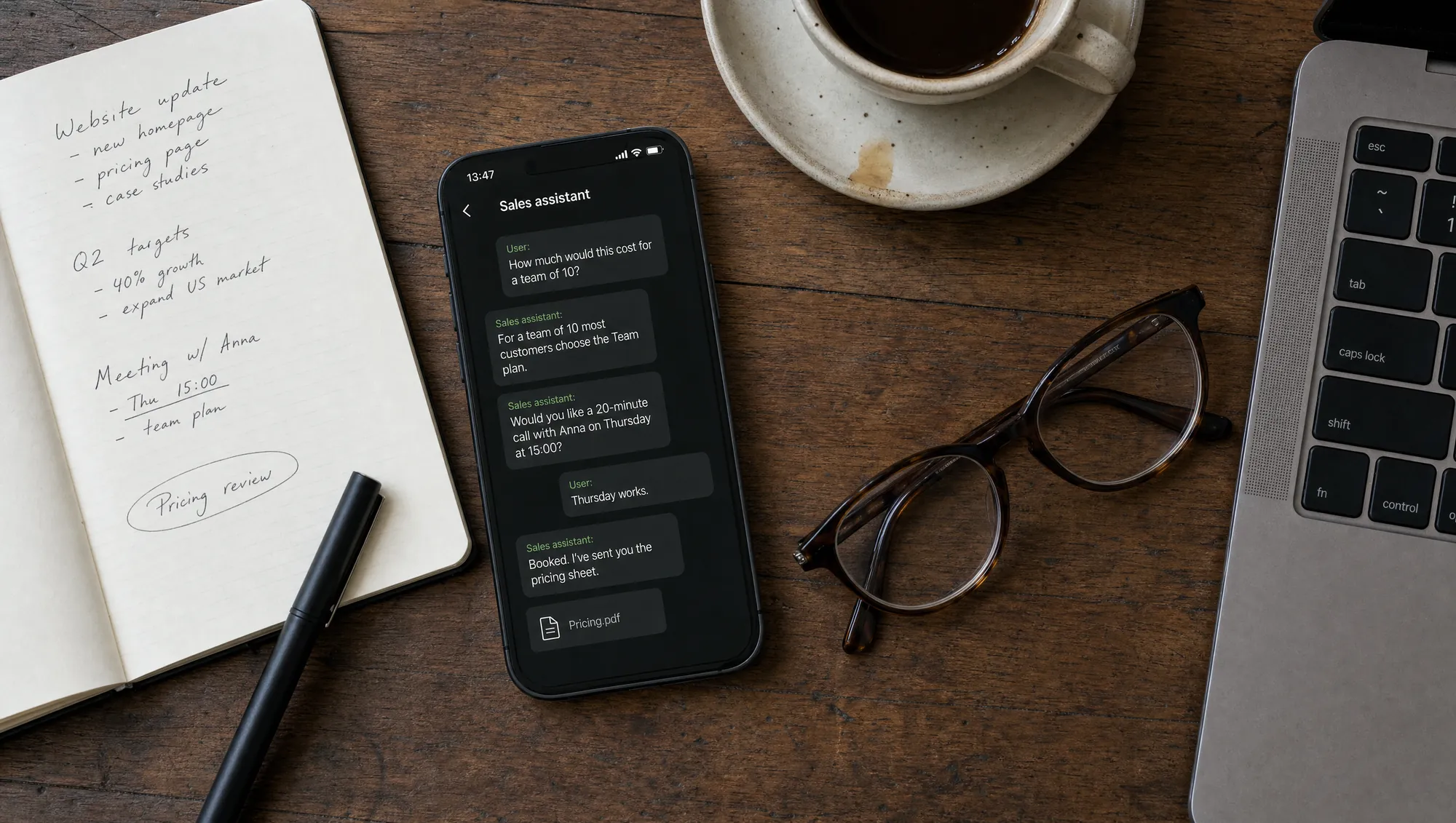
A typical exchange at 9:12 pm:
Visitor: How much would this cost for a team of 10?
AI sales rep: Hi, I'm the company's AI assistant. For a team of 10 most customers choose the Team plan. Before I quote it: are you replacing an existing tool or starting fresh?
Visitor: Replacing one, our contract ends next month.
AI sales rep: Thanks, that helps. Would you like a 20-minute call with Anna, who handles migrations? She has Thursday at 15:00 or Friday at 10:30.
Visitor: Thursday works.
AI sales rep: Booked. I've sent you the pricing sheet.
What it should never do
- Offer discounts, custom terms or contracts. Those go to a person.
- Invent features, prices or delivery dates that are not in the approved material.
- Pretend to be human. It introduces itself as an AI.
- Push a visitor who said no.
How to write your qualifying questions
- Write down what a good lead looks like: company size, use case, timeline, budget range.
- Turn it into three to five questions a person would ask naturally, not a form.
- Define the outcome for each answer: book a call, send material, or pass to a person now.
- Decide who takes which call, so the booking lands with the right colleague.
- Review the first conversations and adjust the wording where visitors hesitate.
How to measure it
- First response time: seconds instead of hours.
- Conversations started per week, and how many came outside working hours.
- Qualified leads and the share that booked a call.
- Show rate of the booked calls.
- Handoffs to a person, and why they happened.
- Unanswered questions: each one shows a gap in your knowledge to fill.
What it costs
Lilidi Twin is priced by conversation minutes. Lite costs $19 a month for a voice Twin with 60 video minutes or 120 audio-only minutes. Professional, at $179, includes 500 video minutes and adds the live video avatar, a personal voice clone and lead capture with the conversation context. Extra minutes cost $0.39 and annual billing saves 20%. See the pricing page.
Questions people ask about AI sales reps
Is an AI sales rep the same as an AI SDR?
Will it give discounts?
Can it book calls in my calendar?
Does it work in WhatsApp?
How do I know which leads are qualified?
Can it sell in other languages?
Related: What is an AI employee? · AI sales rep use case · Compare Lilidi Twin · Talk to a live Twin

Founder & CEO, Lilidi AI
Continue reading
What Is an AI Employee? How It Works, What It Does and What It Costs
An AI employee answers customers, qualifies leads, books meetings and hands over to a person. How it works, what it costs and how it differs from a chatbot.
TechCrunch Disrupt 2026: The AI Sessions Worth Your Time, and Where to Meet Lilidi
Six AI sessions at TechCrunch Disrupt 2026 for founders building with AI agents, with times and stages, plus where to meet Lilidi in San Francisco.
Lilidi Twin vs HeyGen vs Tavus vs Synthesia vs Speechify: From AI Avatars to AI Employees
Compare Lilidi Twin, HeyGen, Tavus, Synthesia and Speechify. See how AI avatars are evolving from video-generation tools into AI employees that can talk to customers, join meetings and perform business workflows.
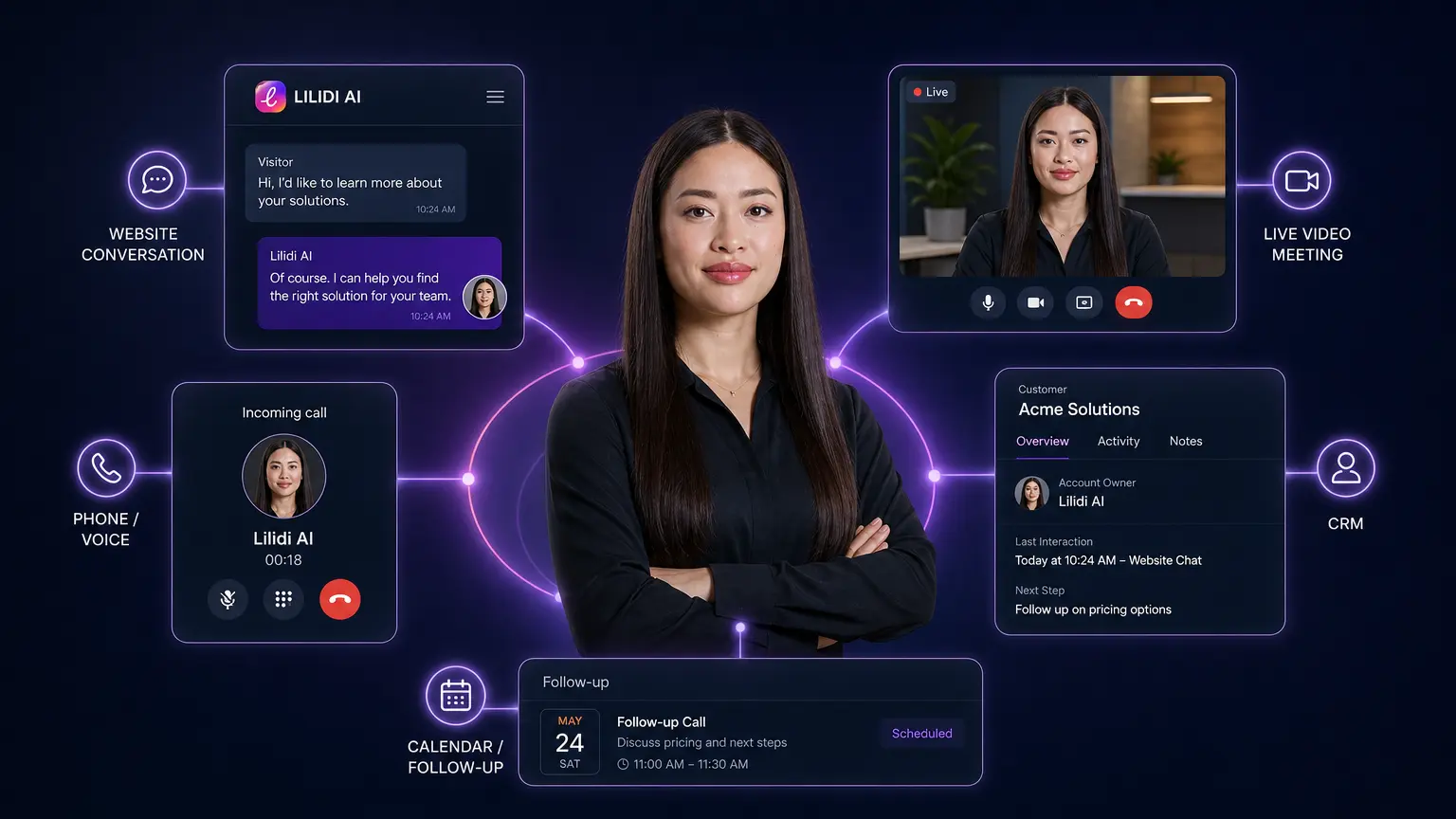
Meet Lilidi Twin, an AI employee for customer conversations
It talks with your website visitors by video, voice or text, qualifies leads, books meetings and joins Zoom, Google Meet and Microsoft Teams calls.