Lilidi Twin vs HeyGen vs Tavus vs Synthesia vs Speechify: From AI Avatars to AI Employees
Compare Lilidi Twin, HeyGen, Tavus, Synthesia and Speechify. See how AI avatars are evolving from video-generation tools into AI employees that can talk to customers, join meetings and perform business workflows.
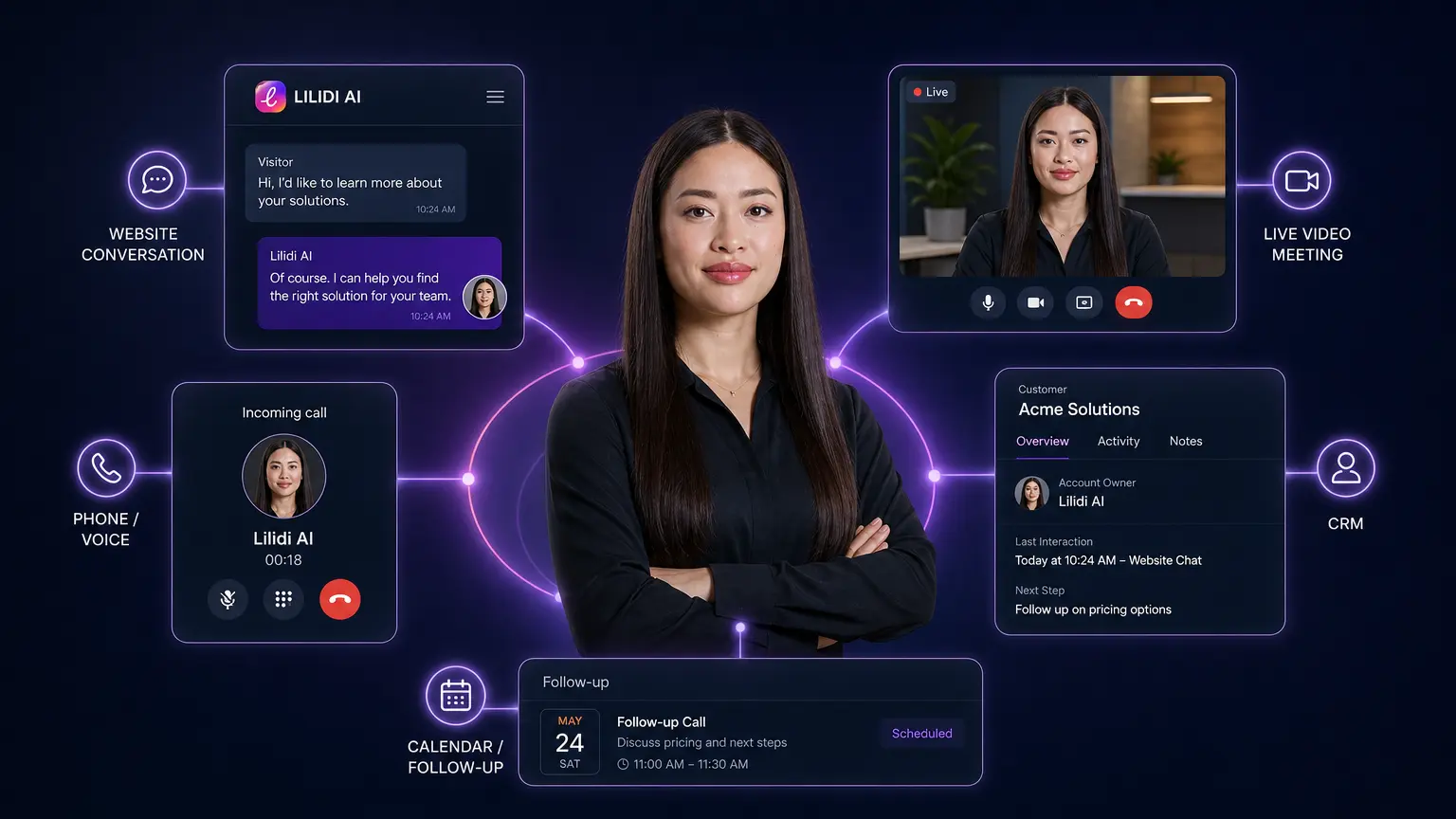
For three years the AI avatar category answered a single question: can a machine produce a video of a person who never stood in front of a camera? HeyGen, Synthesia and Speechify answered it well. The output is a file - an onboarding video, a localised product explainer, a narrated article.
A different question is now being answered: can that same synthetic person hold a live conversation, remember your business, join a scheduled call and finish a task afterwards? That is not video generation. That is an AI employee, and it is the axis on which Lilidi Twin, Tavus, HeyGen, Synthesia and Speechify now separate.
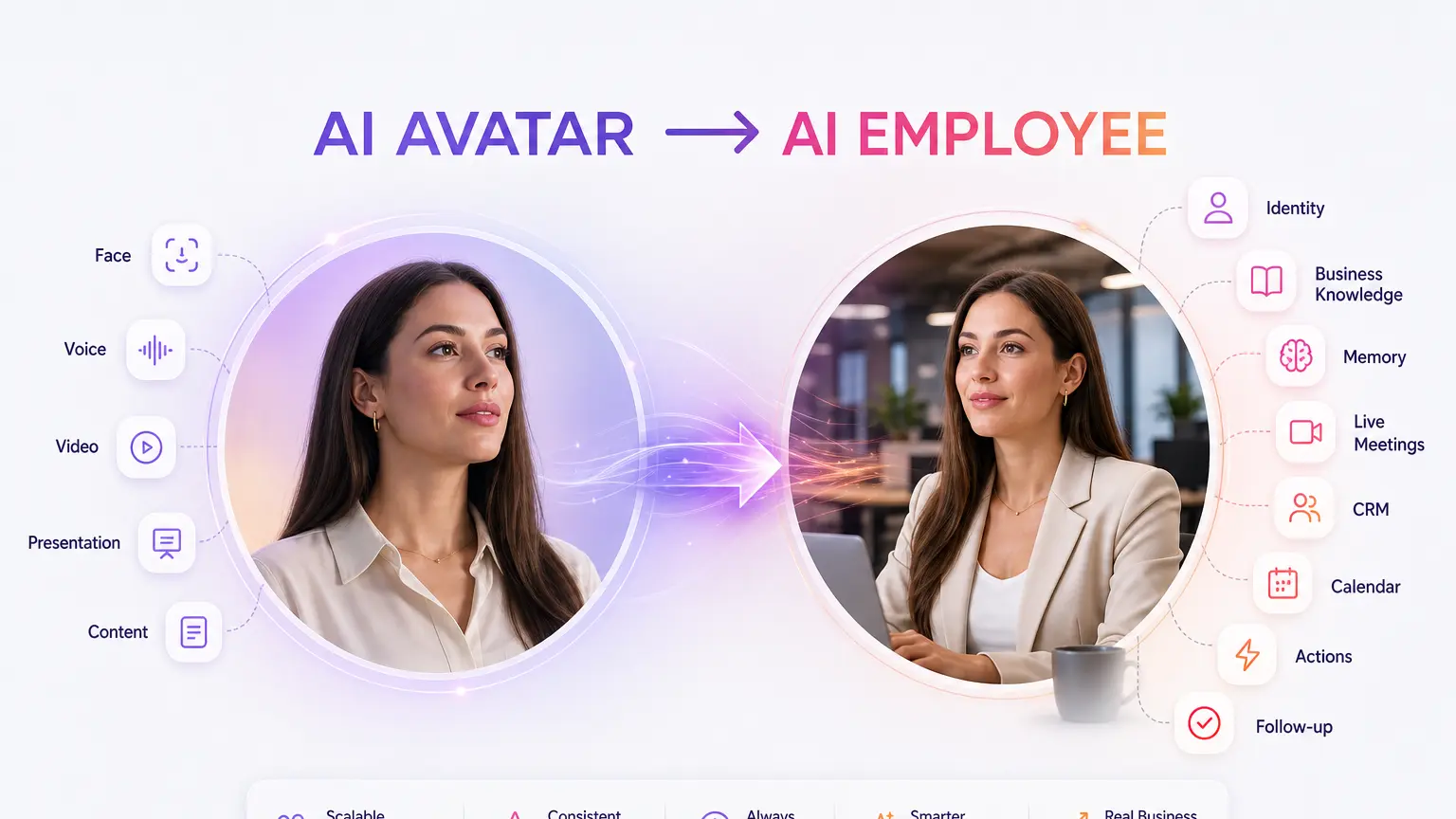
From AI avatars to AI employees
An AI avatar is a rendering layer. You supply a script, it returns a likeness reading that script. Quality is judged on lip-sync, expression and how many languages the voice covers.
An AI employee is a rendering layer plus three things a video file cannot have:
- Knowledge - documents, pricing, product detail and policies it can quote without a script.
- Memory - continuity across sessions, so a returning visitor is not treated as a stranger.
- Actions - capturing a contact, sharing a file, booking a slot, sending a recap, attending a meeting.
The practical test is simple. If the deliverable is a video, you are buying an avatar tool. If the deliverable is a completed job, you are buying an employee.
What each platform is actually built for
HeyGen
Strongest as a production tool for avatar video at volume: cloned likenesses, translation and lip-sync across many languages, and a template-driven editor. The centre of gravity is content output, with interactive avatars available as an additional surface rather than the core promise.
Tavus
The most conversation-native of the incumbents. Tavus is developer-first: real-time video agents you assemble through an API, with a strong focus on latency and turn-taking. It gives engineering teams the conversational primitive, and leaves the business layer - knowledge, CRM, calendar, follow-up - to be built.
Synthesia
An enterprise video platform. Training, compliance, internal comms and localisation at company scale, with the governance and brand controls large organisations require. It is deliberately about produced video, not live dialogue.
Speechify
Primarily a voice and text-to-speech product, with avatar and studio features layered on top. It sits closest to narration and accessibility use cases rather than customer-facing conversation.
Lilidi Twin
Built from the opposite end of the problem. The Twin starts as a job to be done - talk to visitors, answer from your own materials, qualify a lead, attend the meeting, send the recap - and treats the face and voice as the interface to that job.
Comparison: avatar tools vs AI employees
| Capability | Lilidi Twin | HeyGen | Tavus | Synthesia | Speechify |
|---|---|---|---|---|---|
| Primary purpose | AI employee | Avatar video production | Conversational video API | Enterprise video | Voice and narration |
| Scripted video generation | Secondary | Core | Secondary | Core | Core |
| Live two-way conversation | Core | Available | Core | Limited | Limited |
| Answers from your documents | Core | Limited | Build it yourself | Limited | Limited |
| Memory across sessions | Core | Limited | Build it yourself | No | No |
| Joins scheduled meetings | Core | No | Build it yourself | No | No |
| Captures leads and contacts | Core | No | Build it yourself | No | No |
| Sends recaps and follow-up email | Core | No | Build it yourself | No | No |
| Public page, share link, embed | Core | Partial | Build it yourself | Partial | Partial |
| Setup model | No-code wizard | No-code | Developer / API | No-code | No-code |
Capabilities describe how each platform positions its core product at the time of writing. Vendors ship quickly; verify current feature sets on their own documentation before purchasing.
What Lilidi Twin does in practice
A Twin is configured once through a six-step setup - onboarding, voice and face, behaviour, knowledge, a test conversation, then publishing - and the same configuration then serves every surface.
- Talks to visitors on a public page, by voice or by text, using your tone and your positioning.
- Answers from your materials - website, documents, pricing, notes - instead of generic model knowledge.
- Qualifies and captures - name, email, intent, recorded as a client record rather than a lost chat log.
- Shares the right document during the conversation, by topic, without pasting raw links.
- Attends meetings on Google Meet and Zoom - speaking on your behalf, replacing you, or joining silently to take notes.
- Follows up with a recap and a draft email after the call ends.

See it talking
Short unedited clips of a Twin in conversation. The value is not the rendering; it is that nothing here was scripted in advance.
How to choose
- You need polished video at scale - training, product marketing, localisation. Choose Synthesia or HeyGen.
- You need narration and reading - accessibility, audio versions of written content. Choose Speechify.
- You have engineers and want to build your own agent - choose Tavus and budget for the business layer around it.
- You need the job done, not the file - conversations answered, leads captured, meetings attended, follow-ups sent. Choose Lilidi Twin.
Where the category is going
Rendering quality is converging. Every serious platform will soon produce a convincing face and a natural voice, which means the face stops being the product. What remains scarce is everything behind it: accurate knowledge of one specific business, memory that survives the session, permission to act, and an audit trail of what was said and promised.
That is the difference between an avatar you generate and an employee you hire. The next two years of this category will be decided on the second one.
FAQ
What is the difference between an AI avatar and an AI employee?
Is Lilidi Twin a HeyGen, Tavus or Synthesia alternative?
Can an AI employee join Google Meet or Zoom calls?
Do I need engineers to set up an AI employee?
Which platform is best for AI avatar video in 2026?
Try it
Meet a live Twin on the Lilidi Twin page, or compare plans on Twin pricing.

Founder & CEO at Lilidi AI
Continue reading
AI Sales Rep for Your Website: Answer, Qualify and Book Every Inbound Lead
An AI sales rep on your website answers pricing questions, qualifies inbound leads and books calls, day or night. How it works and how to measure it.
TechCrunch Disrupt 2026: The AI Sessions Worth Your Time, and Where to Meet Lilidi
Six AI sessions at TechCrunch Disrupt 2026 for founders building with AI agents, with times and stages, plus where to meet Lilidi in San Francisco.
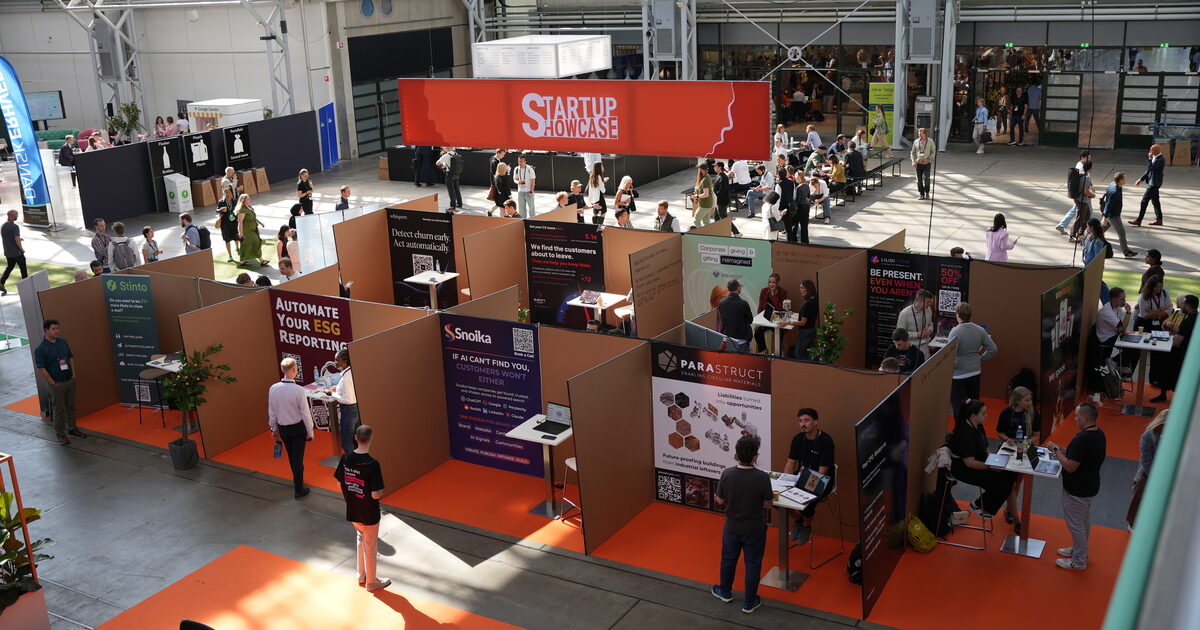
TechBBQ 2026 Copenhagen: Inside the Startup Showcase with Lilidi AI
First-hand recap of TechBBQ 2026 at Bella Center Copenhagen: the Startup Showcase floor, agentic AI on stage, the people we met, and an exhibitor playbook for founders taking a booth - in 22 photos.
Meet Lilidi Twin, an AI employee for customer conversations
It talks with your website visitors by video, voice or text, qualifies leads, books meetings and joins Zoom, Google Meet and Microsoft Teams calls.